The early years…
In 1950, at the age of twelve, there were no organized youth leagues like Little League. Nevertheless, he attended Tris Speaker’s baseball camp in North Braddock, Pennsylvania, where he pitched his team to the championship and was named MVP. That same year, he was recruited to play basketball for the First Presbyterian Saints, averaging 12 points per game and earning MVP honors. His coach, Bill White, ensured eligibility by requiring the team to attend Sunday School at least twice a month, often picking up the players and taking them to church.
In 1952, Hawker was selected as All-City Quarterback for Green Street Park. That year also marked the organization of Pony League baseball, where he played for the Crescent Drive-In team under Coach Nick Warren. Pitching and playing shortstop, he helped secure the league title, won the batting title with a .342 average, and remained undefeated as a pitcher. In one memorable game, he pitched 15 innings to a 1-0 victory, allowing six hits and striking out 29 batters, while Don Chandler took the loss after pitching 15 innings. Selected for the All-Star team, they advanced to the regionals in Elizabethton, Tennessee. Hawker pitched and won the first game, propelling them to the finals. However, after the game, while playing chicken in a boxing ring, he fell from a teammate’s shoulders over the top rope, hitting his head on the gym’s wooden floor. Hospitalized overnight, he was unable to play in the finals, where his team lost to the home squad.
The High School years…
At fifteen, Hawker became the starting quarterback on George Washington High School’s junior varsity football team. In basketball, he started for the freshman team, scoring 35 points in his debut against Roxboro High School. He also made the varsity baseball team as a freshman, contributing to their state championship win.
During his sophomore year, A broken hand sidelined him from football, but toward the end of basketball season, he was promoted to varsity. Hawker started at shortstop on the baseball team, which claimed its second consecutive state championship.
In his junior year, he served as the second-team quarterback on varsity football, playing all forty quarters as a defensive halfback. The football team shared co-state champion honors with Woodrow Wilson of Portsmouth. Starting for the varsity basketball team, he was chosen MVP by his teammates. Leon played shortstop on the varsity baseball team, but no championship was held that year.
As a senior, He started at quarterback in football but missed most of the season due to a fractured right hand. In basketball, he led the team in scoring as they won the district championship. Selected as captain of the Western District team, he was one of five players named to the All-State squad and made first team at the state tournament in Richmond. Hawker pitched and played shortstop on the baseball team, losing only one game—to Drewry-Mason, 1-0. To cap his high school career, he was honored as the most valuable athlete.
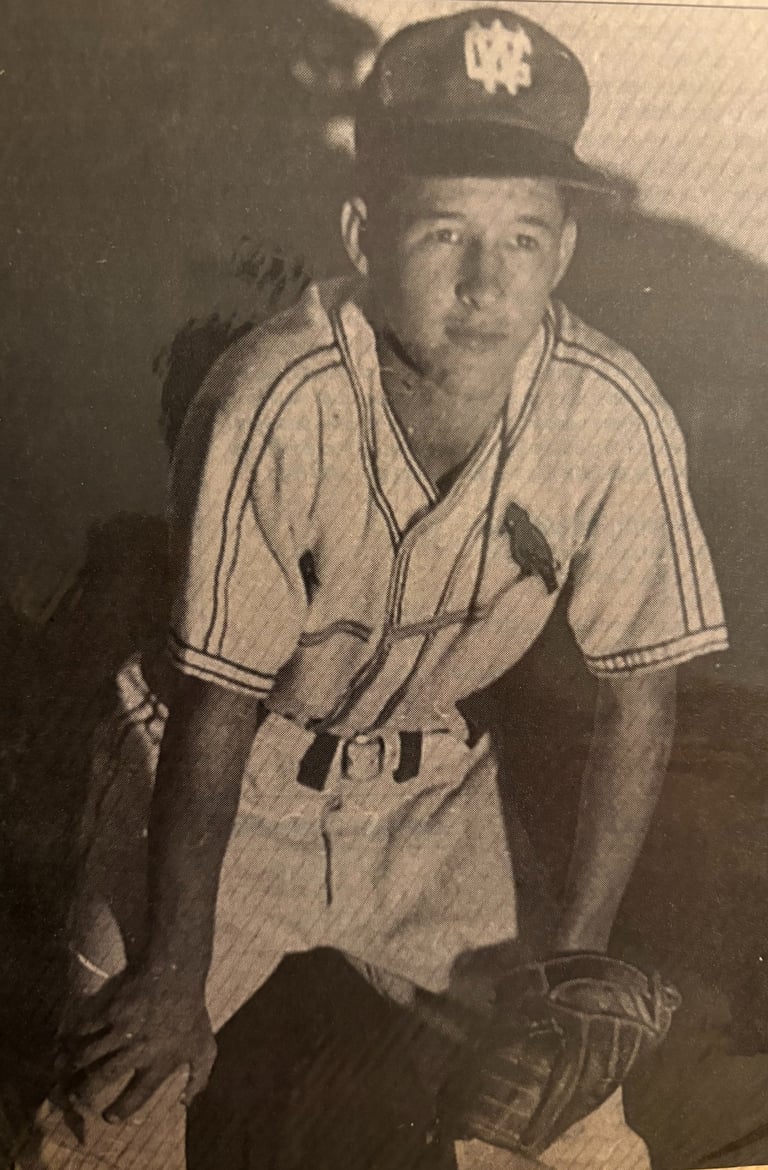
Each year, the Black semi-pro baseball team selected two high school players to join them. Hawker and Frank Cowan were chosen, playing doubleheaders on weekends at Peters Park in Danville and fields in South Boston and Clarksville. In the first game, Cowan pitched while Hawker caught; they switched roles in the second. They earned $15 to $20 per weekend.
The college years…
In the fall of 1956, Hawker entered Hampden Sydney College. He started on the basketball team, leading in scoring and earning first-team All-Little Eight Conference honors, as well as the only player in school history to be chosen first team All Mason District Conference as a freshman. He was listed in Who’s Who in small colleges, named honorary Little American, and selected first team at the Christmas Collegiate Basketball Tournament alongside two All-Americans. Starting at shortstop on the baseball team, he encountered a setback in a game against the University of Richmond when he failed to run out a ground ball and was thrown out at first. Coach Miller benched him, and in frustration, Hawker left for the dressing room. Due to his poor attitude, the team voted to remove him. They went on to win the Mason-Dixon Conference Championship. Though he considered leaving school, Coach Miller and the college chaplain of Hampden Sydney convinced him to stay. School policy prohibited playing three sports due to academic demands, so he did not play football.
Before his sophomore basketball season, Hawker sustained a compound fracture of his left wrist. He played but not at full capacity, earning second-team All-Little Eight honors. Starting at shortstop in baseball, the team won the Mason-Dixon Championship for the second straight year. That summer, he played for the New Market team in a league featuring college and ex-pro players. They captured the championship. An anonymous benefactor covered his housing in Harrisonburg, Virginia, and summer school costs at Madison College, plus $300 spending money. In a game in Luray, Virginia, with the bases loaded, he was struck in the left temple by a pitch he never saw coming. In his previous at-bat, he had hit a home run.There were no helmets at that time. Hospitalized for three days, he was released to Mr. and Mrs. White in New Market for a week’s care before returning to classes.
As a junior at Hampden-Sydney, Hawker started on both basketball and baseball teams. Again chosen first-team All-Little Eight in basketball, he led in scoring and won the Dr. Ray A. Moore Award (equivalent to MVP). In one recorded baseball feat, he tagged up from first base and scored on a fly ball to left-center; the centerfielder ran into the fence, the relay was overthrown, and the throw home was wide. The baseball team won the Mason-Dixon Conference for the third consecutive year.
In his senior year, Hawker was the leading scorer in basketball. He was selected All-Little Eight Conference—the only Hampden-Sydney player chosen all four years—and won the Dr. Ray A. Moore Award again, becoming the only athlete to win it three times. He tallied 1,861 points over four years, averaging 19.6 per game, with multiple 30+ point games, including a gym-record 39 against Johns Hopkins. His teams won 59 games and lost 37, the best four-year record in school history. In baseball Hawker pitched and played shortstop his senior year, losing only one game as a pitcher—to Loyola of Maryland, 2-1. He earned first-team All-Mason-Dixon at shortstop and second-team as pitcher. Someone claimed he was possibly the greatest athlete to wear the Garnet and Gray, his Hall of Fame induction: https://hscathletics.com/honors/hall-of-fame/leon-hawker/19
After college…
Recruited by the Los Angeles Dodgers and Baltimore Orioles, Hawker signed abruptly with the Dodgers for a $10,000 bonus while studying for exams. Two weeks later, the Orioles offered $20,000, but it was too late. Weeks after graduating from Hampden Sydney with a Bachelor of Arts, he reported to the Orlando Dodgers in the Florida State League, starting his pro career hitting .375. Opponents adjusted by throwing sliders, leading to groundouts and a slump—“killing worms,” as it was called. Frustrated, he left the team but returned after family encouragement, fined $75 and suspended five games. Adapting to hit sliders to right field, he finished at .220—his lowest average ever. Facing Sam McDowell in his pro debut (signed by Pittsburgh for $75,000), Hawker struck out on a quick pitch but got one of two hits in McDowell’s two-hitter. McDowell later pitched for the Cleveland Indians in the majors. Other Florida State League alumni who reached the majors included Tommy Helms, Pat Corrales, Dave Bristol, Ken Harrelson “the Hawk”, and McDowell.
In 1961, Hawker attended spring training in Vera Beach, Florida, without a contract, expecting to negotiate. Unable to agree, he lost his passion for baseball and left permanently, pursuing a professional career. He played local baseball around Danville, combining with Ronnie Belton for a no-hitter in Yanceyville, with former major leaguer, Neal Watlington catching. With friends, he played stickball using a cut-off broom handle as a bat and a perforated PGX golf ball. He pitched and batted left-handed only twice in organized games: a home run at Lynchburg College and a double off the fence in a Winchester fast-pitch softball game, both when his team led comfortably. Success batting right-handed deterred more lefty attempts.
In summer 1962, Hawker pitched against a New York All-Star team, switching sides—lefty to left-handed hitters, righty to righties—and won 6-4.
Married Life…
Engaged to his wife with a ring on Christmas 1960, they married April 8, 1961, seeing no reason to wait. He often reflected on his blessings: a wonderful wife, three children, eight grandchildren, and eight great-grandchildren.
After years of baseball, Hawker transitioned to fast-pitch softball, playing on five Virginia state championship teams and earning MVP at the state tournament three times. He faced elite pitchers like Bob Saunders (who threw a perfect game against them, with two bunts and 19 strikeouts), “Sea Biscuit” Simmons, Joe Lewis Abney, Mel Stofflet, Tom Davenport, and Bill Dudley of Clearwater, Florida (beaten 4-3 in Dover, Delaware, on David Crawford’s seventh-inning grand slam). They lost 3-2 in 13 innings to Rising Sun of Pennsylvania, just missing the World Series. He also batted against Eddie Feigner of the King and His Court, tying 1-1 in nine innings with Feigner’s minimal team.
Golfing for fun…
Starting golf at age nine, Hawker improved from a high handicap to a two at age thirty-five (versus the average golfer’s 18). He twice qualified as a runner-up for the U.S. Senior Open: shooting even-par 72 at New Orleans Country Club (beaten by a pro’s 71) and 74 in Birmingham (beaten by a pro’s 72), but lacked funds to attend as an alternate. He achieved six holes-in-one: three in Virginia, two in Alabama, one in Myrtle Beach. He scored 29 on nine holes twice—at Skyline Country Club in Mobile (front nine) and Glen Oak in Danville (back nine). In 1977, paired with Krispy Kreme founder Mr. McAleer, they won the first flight at Skyline’s invitational with Hawker’s 64 and 66 (16 under par, outscoring the championship flight). The next day, he shot 71, totaling 17 birdies, an eagle, and four bogeys over three days. With Tommy Marr, he won Skyline’s Memorial Day tournament on a holed chip in the third playoff hole. Health issues forced him to quit at 81, carrying an eight handicap.
Inducted into the Hampden-Sydney Hall of Fame in 1990, Hawker also entered Danville’s Hall of Fame as a player and twice as part of state championship baseball teams. Nominated for Virginia’s Hall of Fame, he fell short of votes.
After retiring from Crawford and Company Risk Management, he coached at UMS-Wright private school in Mobile. His varsity girls’ slow-pitch softball teams reached the state tournament annually. He also coached ninth-grade football and basketball, plus JV baseball. Earlier, he led a Little League team to a championship and an 18-and-under squad to regionals in Lynchburg, losing 1-0 in the World Series in Chicago.
Remembering
Leon's Journey
LeonWHawker.com
© 2026. All rights reserved.